
Recently, the 2026 Space Photovoltaic Prospective Technology Innovation Forum was held in Beijing. Dr. Li Guo, Senior R & D Engineer of Tong Wei Photovoltaic Technology Center, was invited to attend and delivered a keynote speech entitled "Advantages of Ultra-thin p-type Heterojunction Silicon-based Solar Cells in Space Environment", starting from the energy demand brought about by the explosion of commer cial space. This paper systematically explains Tongwei's technical judgment and R & D layout for low earth orbit environment. The rapid development of LEO satellite constellation, space computing power and space infrastructure at the
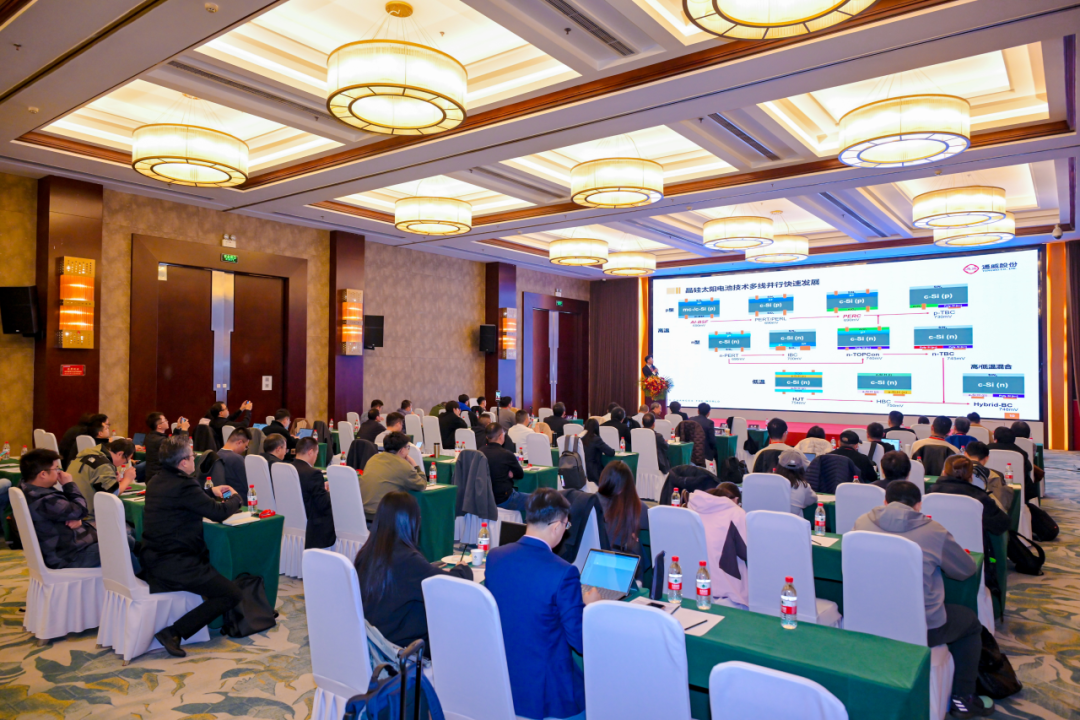
conference
site is pushing "space photovoltaic" from concept to large-scale application. Compared with traditional III-V batteries such as gallium arsenide, the crystalline silicon route has significant advantages in terms of cost, capacity and industrial chain maturity, while the space environment is not a simple translation of ground products-the ultraviolet irradiation under the AM0 spectrum is greatly enhanced, the temperature alternates violently between -170 C and + 150 C, and the high-energy particles will continue to bombard the silicon lattice and cause irradiation damage. Who can carry the triple pressure of "strong light, extreme temperature and radiation" at the same time, who is qualified to go to heaven. Dr. Li Guo, senior R & D engineer
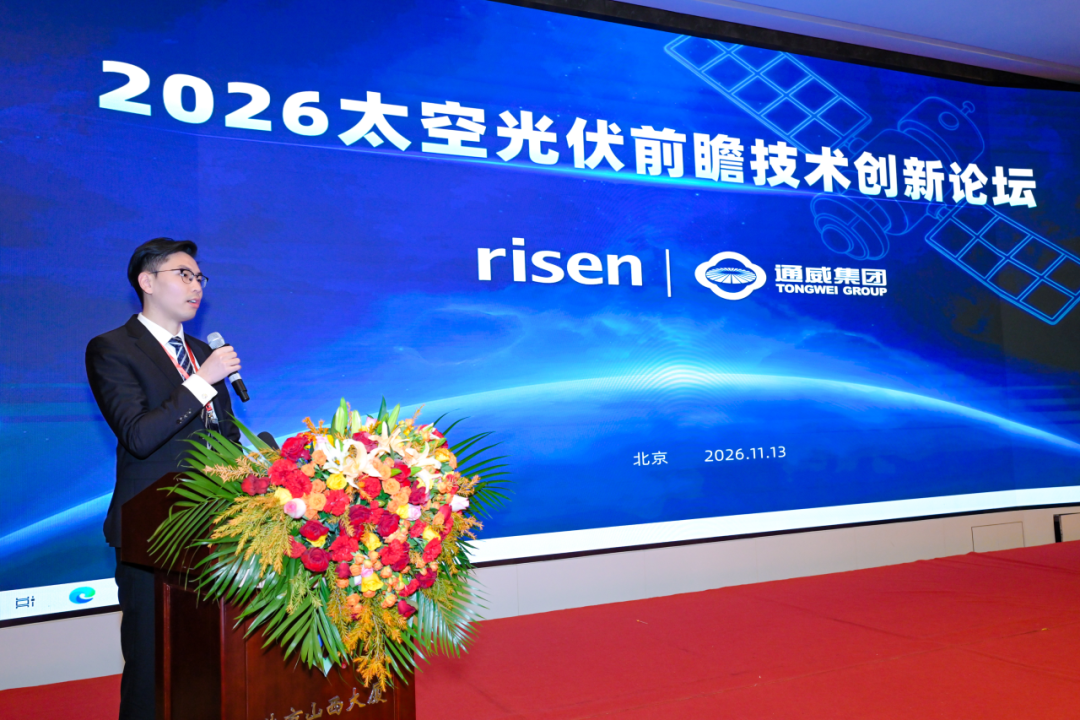
of Tongwei Photovoltaic Technology Center, made a report
based on semiconductor physics and reliability analysis. Dr. Li Guo proposed that the preferred path for space crystalline silicon cells is "gallium doped p-type silicon wafer + heterojunction structure + ultra-thin + copper interconnection". The p-type substrate has higher minority carrier migration rate and lower radiation damage coefficient, and the high-resistivity gallium-doped silicon has better irradiation resistance performance; the HJT positive junction structure enables the minority carrier collection path to be the shortest, and high-efficiency light collection and power generation can still be realized when the minority carrier lifetime is reduced after irradiation; the ultra-thin substrate shortens the path of carriers to be taken to the shortest, and reduces the defect capture probability; The copper electroplated pure metal grid line reduces the introduction of organic matter, and takes into account both lightweight and long-term reliability with ultra-dense and ultra-fine patterns. At present, the AM0 efficiency of Tongwei's battery has exceeded 21.5%. This scheme is
supported by Tongwei's technical precipitation in the field of high-efficiency crystalline silicon for many years. As the only Fortune 500 enterprise in the global photovoltaic industry, Tongwei has realized the preparation of 55μm ultra-thin HJT battery by relying on the vertical integration industry chain and the global innovation R & D center, and the related achievements have appeared on the cover of Nature; the copper interconnection technology is planned to enter GW level mass production from 2026 to 2027, and the width of the grid line is less than 20μm; At the same time, the industry's first 5MW fully automatic perovskite- crystalline silicon stack test line has been built to reserve iterative space for the next generation of space batteries with higher power density.
From the ground to the space, every extrapolation of the boundary of photovoltaic technology is inseparable from the collaborative reconstruction of materials, structures, processes and standards. At present, space photovoltaic still needs to overcome engineering issues such as space-grade reliability verification, batch automation manufacturing and exclusive testing standards. Tongwei will continue to respond to the real needs of space scenarios with low-level innovation, and transform the manufacturing capacity of ground photovoltaic into China's plan for space energy.


 浙公网安备33010802003254号