
According to the relevant provisions of the approval procedures for environmental impact assessment of construction projects, after examination, our Bureau intends to give approval opinions on the functional protective film and display film project of Jiangxi Ronghong New Materials Co., Ltd. In order to ensure the seriousness and impartiality of the review, the basic information of the environmental impact assessment documents of the project is now publicized. The publicity period is from May 11, 2026 to May 15, 2026 (5 working days).
Notice of Hearing: In accordance with the Administrative License Law of the People's Republic of China, the applicant and interested parties may request a hearing on the following approval opinions on the EIA documents of the construction project to be made within five days from the date of publication.
Contact number : 0793-8 224065
ground address : west side of Guangping Street, Shangrao Administrative Center
email : sr xzfwk @ 163.com
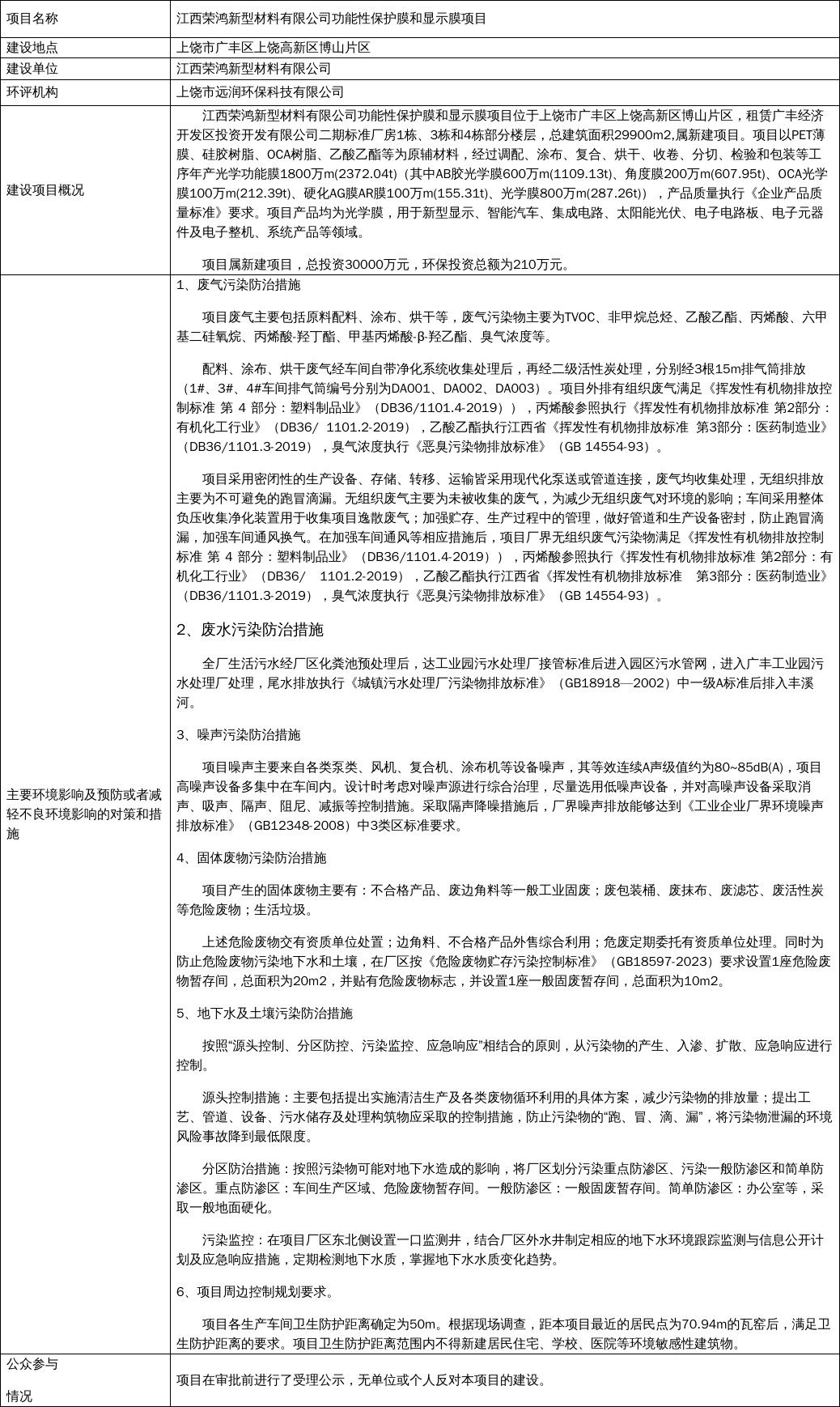
| project name | Functional Protective Film and Display Film Project of Jiangxi Ronghong New Materials Co., Ltd. |
| build site | Boshan Area, Shangrao High-tech Zone, Guangfeng District, Shangrao City |
| construction unit | Jiangxi Ronghong New Material Co., Ltd. |
| EIA Agency | Shangrao yuanrun Environmental Protection Technology Co., Ltd. |
| Construction Project Overview | Jiangxi Ronghong New Materials Co., Ltd. is located in Boshan District, Shangrao High-tech Zone, Guangfeng District, Shangrao City. It leases part of the floors of Building 1, Building 3 and Building 4 of the second phase standard workshop of Guangfeng Economic Development Zone Investment and Development Co., Ltd. with a total construction area of 29900 m2. It is a new project. The project uses pet film, silica gel resin, OCA resin and ethyl acetate as raw and auxiliary materials. The annual output of optical functional film is 18 million m (2372.04 t) (including 6 million m (1109.13 t) of AB adhesive optical film, 2 million m (607.95 t) of angle film, 1 million m (212.39 t) of OCA optical film, Hardened AG film AR film 1 million m (155.31 t), optical film 8 million m (287.26 t)), and the product quality shall comply with the requirements of Enterprise Product Quality Standard. The products of the project are all optical films, which are used in new display, smart cars, integrated circuits, solar photovoltaic , electronic circuit boards, electronic components, electronic machines, system products and other fields. The project is a new project with a total investment of 300 million yuan and a total environmental protection investment of 2.1 million yuan. |
| Major environmental impacts and countermeasures and measures to prevent or mitigate adverse environmental impacts | 1. Waste gas pollution prevention measures the project mainly includes raw material batching, coating, drying, etc., and the waste gas pollutants mainly include TVOC, non-methane total hydrocarbon, ethyl acetate, acrylic acid, hexamethyldisiloxane, acrylic acid-hydroxybutyl ester, methacrylic acid-β-hydroxyethyl ester, odor concentration, etc. The waste gas from batching, coating and drying is collected and treated by the purification system of the workshop, and then treated by secondary activated carbon, and discharged through three 15m exhaust funnels (the exhaust funnels of 1 , 3 # and 4 # workshops are numbered DA001, DA002 and DA003 respectively). The organized waste gas discharged from the project meets the Emission Control Standard for Volatile Organic Compounds-Part 4: Plastic Products Industry (DB36/1101.4-2019), and acrylic acid is subject to the Emission Standard for Volatile Organic Compounds-Part 2: Organic Chemical Industry (DB36/1101.2-2019). Ethyl acetate is subject to the Emission Standard of Volatile Organic Compounds Part 3: Pharmaceutical Manufacturing Industry (DB36/1101.3-2019) of Jiangxi Province, and the odor concentration is subject to the Emission Standard of Odor Pollutants (GB 14554-93). The project adopts closed production equipment, storage, transfer and transportation are all connected by modern pumping or pipeline, waste gas is collected and treated, and unorganized emission is mainly inevitable leakage. Unorganized waste gas is mainly the waste gas that is not collected. In order to reduce the impact of unorganized waste gas on the environment, the workshop adopts an integral negative pressure collection and purification device to collect the waste gas escaping from the project. Strengthen the management in the storage and production process, seal the pipeline and production equipment to prevent leakage, and strengthen the ventilation of the workshop. After strengthening workshop ventilation and other corresponding measures, the unorganized waste gas pollutants at the project boundary meet the requirements of Volatile Organic Compounds Emission Control Standard Part 4: Plastic Products Industry (DB36/1101.4-2019). Acrylic acid is subject to the Emission Standard of Volatile Organic Compounds Part 2: Organic Chemical Industry (DB36/1101.2-2019), and ethyl acetate is subject to the Emission Standard of Volatile Organic Compounds Part 3: Pharmaceutical Manufacturing Industry (DB36/1101.3-2019) of Jiangxi Province. The odor concentration shall comply with the Emission Standard for Odor Pollutants (GB 14554-93). 2. Wastewater pollution prevention measures the whole plant is pretreated by the septic tank in the plant area, and then enters the sewage pipe network of the industrial park after reaching the takeover standard of the sewage treatment plant in the industrial park, and then enters the sewage treatment plant in Guangfeng Industrial Park for treatment. The tail water is discharged into Fengxi River according to the first class A standard in the Discharge Standard of Pollutants for Urban Sewage Treatment Plant ( GB18918-2002) . 3. Noise pollution prevention measures The noise of the project mainly comes from various pumps, fans, laminating machines, coating machines and other equipment, and the equivalent continuous A sound level value is about 80 ~ 85dB (A). The high-noise equipment of the project is mostly concentrated in the workshop.". Comprehensive treatment of noise sources shall be considered in the design, and low-noise equipment shall be selected as far as possible, and control measures such as noise elimination, sound absorption, sound insulation, damping and vibration reduction shall be taken for high-noise equipment. After taking sound insulation and noise reduction measures, the noise emission at the factory boundary can meet the requirements of Class 3 area standard in the Emission Standard for Environmental Noise at Boundary of Industrial Enterprises (GB12348-2008). 4. Solid waste pollution prevention measures project mainly include: general industrial solid wastes such as unqualified products and waste scraps; hazardous wastes such as waste packaging barrels, waste rags, waste filter elements and waste activated carbon; and domestic garbage. The above-mentioned hazardous wastes shall be handed over to the qualified unit for disposal; the leftover materials and unqualified products shall be sold for comprehensive utilization; the hazardous wastes shall be regularly entrusted to the qualified unit for disposal. At the same time, in order to prevent hazardous wastes from polluting groundwater and soil, a hazardous waste temporary storage room with a total area of 20 m2 and a general solid waste temporary storage room with a total area of 10 m2 shall be set up in the plant area according to the requirements of the Pollution Control Standard for Hazardous Waste Storage ( GB18597-2023). 5. Groundwater and soil pollution prevention measures According to the principle of combining "source control, zoning provention and control, pollution monitoring and emergency response", the generation, infiltration, diffusion and emergency response of pollutants are controlled. Source control measures: mainly include proposing specific plans for implementing cleaner production and recycling of various wastes to reduce the discharge of pollutants; Propose the control measures to be taken for process, pipeline, equipment, sewage storage and treatment structures to prevent the "running, emitting, dripping and leaking" of pollutants and minimize the environmental risk accidents caused by pollutant leakage. Zoning control measures: According to the possible impact of pollutants on groundwater, the plant area is divided into key anti-seepage area of pollution, general anti-seepage area of pollution and simple anti-seepage area.". Key anti-seepage area: workshop production area and hazardous waste temporary storage room. General anti-seepage area: temporary storage room for general solid wastes. Simple anti-seepage area: office, etc., general ground hardening is adopted. Pollution monitoring: a monitoring well is set up in the northeast of the plant area of the project, and the corresponding groundwater environment tracking monitoring and information disclosure plan and emergency response measures are formulated in combination with the wells outside the plant area, so as to regularly detect the groundwater quality and grasp the change trend of groundwater quality. 6. Control planning requirements for project surroundings. The health protection distance of each production workshop of the project is determined to be 50 m. According to the field survey, the nearest residential area to the project is behind the tile kiln of 70.94 m, which meets the requirements of health protection distance. No new residential buildings, schools, hospitals and other environmentally sensitive buildings shall be built within the health protection distance of the project. |
| Public Participation case | The project has been accepted and publicized before approval, and no unit or individual objects to the construction of the project. |


 浙公网安备33010802003254号