
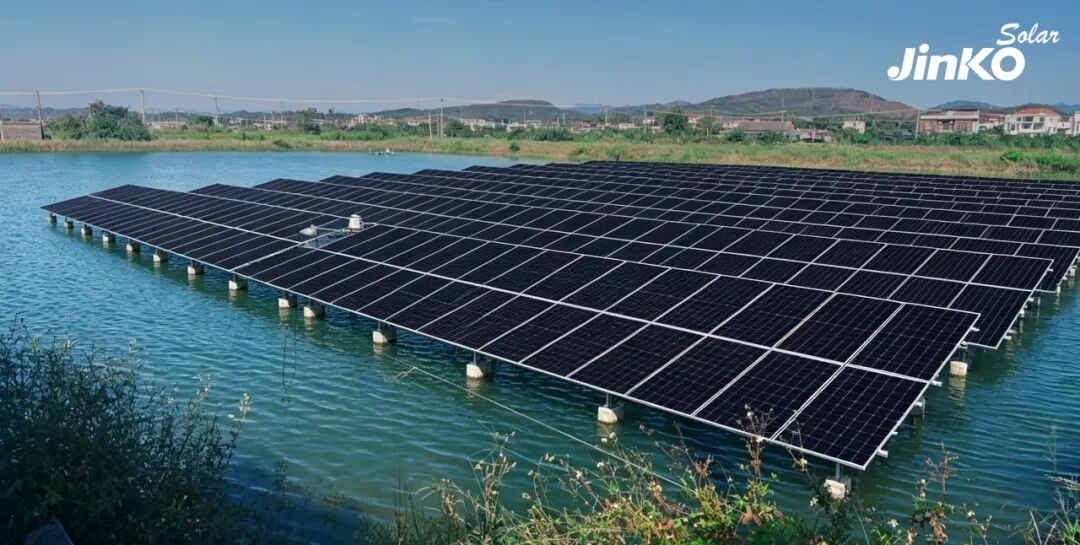
Recently, the successful candidate for the procurement of photovoltaic module framework for the fourth phase of Dongxing Jiang ping Fishery Complementary Photovoltaic Project of Guoneng Guangxi Company was announced. JinkoSolar won the bid by virtue of the integrated scenario adaptation capability of Tiger Neo 3.0, and will supply 151.8 MW high-efficiency N-type modules for the project. Higher power generation per watt means stronger power generation capacity and lower LCOE under the same installed capacity, which is the core logic of Feihu 3 winning the bid. Power generation per watt is generated
by AI
in this figure: the parameter system of Feihu 3, which defines the output baseline
by power generation capacity, is expanded around the unit installed output: the battery efficiency is 27%, the module efficiency is up to 24.8%, the single chip power is up to 670 W, and the temperature coefficient is as low as -0.26%/℃. High efficiency determines the upper limit of conversion per unit area, and low temperature coefficient compresses the power loss under high temperature conditions, which together narrow the difference between nominal power and actual output, and constitute the output baseline of single watt power generation.
Low light and double-sided ratio: the difference of power generation per watt with the same installed capacity and higher output
is more reflected in the period when the irradiation deviates from the rated working condition. The double-sided rate of Flying Tiger 3 is 85% ± 5%, and the back gain is included in the output calculation of unit installation; in the low irradiation environment of 200 W/m ², the relative power output is maintained at 95% -98%, and the gain of power generation in the low irradiation period is more than 4% compared with the N-type BC module. Under the condition of long side occlusion, the residual power is increased by about 20% compared with similar products, which reduces the occlusion loss and suppresses the potential hot spot risk. The double-sided ratio corresponds to the back gain, the low-light performance corresponds to the output maintenance in the low irradiation period, and the superposition of the two items raises the full life cycle power generation.
High power density: Dilute BOS and LCOE to reduce the value of a single watt of power generation by 6%
, which is ultimately realized by the cost of electricity. It is estimated that the highest power density of Flying Tiger 3 modules is 670 W, which can reduce the number of modules and installation man-hours under the same capacity arrangement, save about 8% -10% of BOS cost, and reduce the cost per kilowatt hour (LCOE) by more than 6% compared with BC technology. The first-year attenuation is less than 1%, the linear attenuation is guaranteed to be 0.35%/year, and the 30-year power warranty makes the gain sustainable and auditable. Through the IEC 61701 salt spray test, Feihu 3 is equipped with high anti-water vapor frame and high reliability packaging, which can control the attenuation caused by environmental erosion and the cost of operation and maintenance in a predictable range, and ensure the full-cycle power generation capacity.
What Feihu 3 delivers is not a set of scattered component parameters, but a convertible revenue path. The winner or loser of component selection has shifted from single price to comprehensive power generation in the whole life cycle-the successful bidding of Guoneng Dongxing Project is another landing of this selection logic.


 浙公网安备33010802003254号