
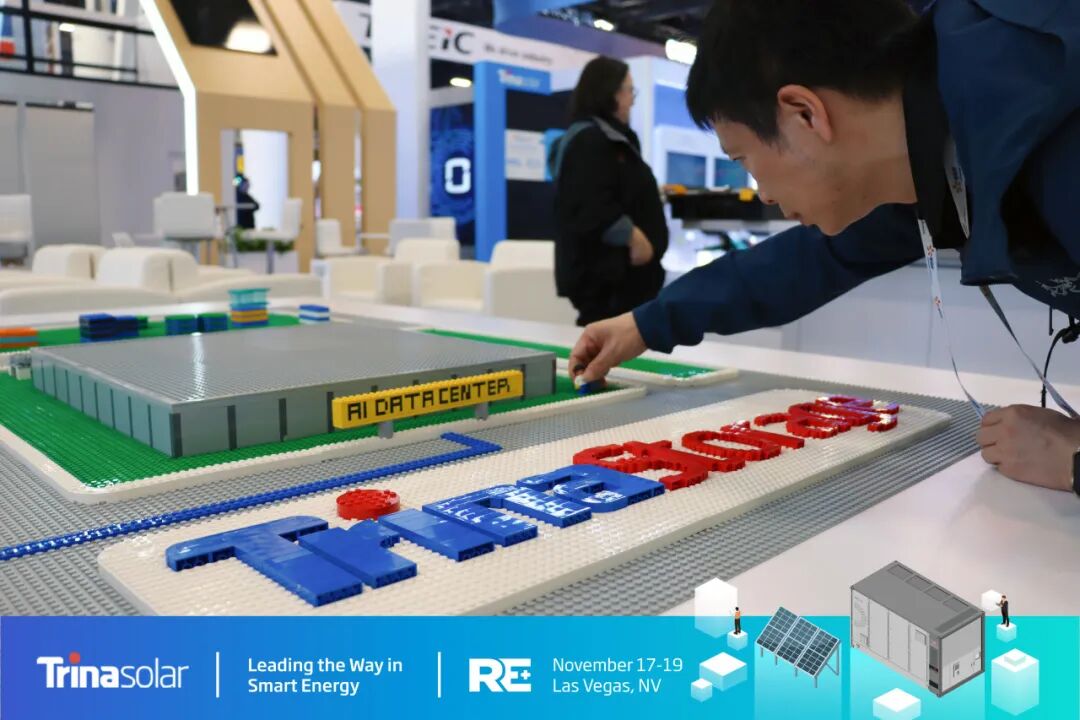
From November 16 to 19, the American International Solar Energy Exhibition (RE + 2026) was held in Las Vegas. Tianhe Energy Storage , the world's leading provider of energy storage products and solutions, officially released a Elementa Hybrid Genset to provide system-level power solutions for AI data center construction with modular gas-fired power generation and energy storage integrated power supply solutions. Following the preview at Data Center World Power in September 2026, the scheme appeared in RE +, further presenting the system integration idea of Tianhe Energy Storage for AI Data Center.
Faced with the challenge of power supply
, many visitors entered the Tianhe Energy Storage booth to learn about the synergy mechanism of gas-fired power generation, energy storage and hybrid control, and exchanged with the Tianhe Energy Storage team around the power supply needs of data centers under different grid connection conditions. The power supply system of
AI data center needs to balance continuous energy supply and fast power response. Gas-fired units can provide continuous power, but may not be able to follow rapid and large load changes in time when operating alone; battery energy storage can respond quickly to load fluctuations, but it is not designed to cope with long-term power outages independently. Based on the complementary characteristics of the two technologies, the Elementa Hybrid Genset integrates gas-fired power generation equipment with Elementa DC battery system, Electra AC platform and hybrid power station controller in a unified architecture. Tianhe Energy Storage is responsible for system integration, and power generation equipment is provided by approved engine partners.
Under this architecture, the gas-fired power generation side uses reciprocating engines with a single unit power of up to 2.5 MW, which supports modular configuration. The Elementa + Electra battery energy storage system provides fast power response and networking capability. The reference configuration is based on 5 MW and 10 MW power modules. The hybrid plant controller uses a scalable architecture and is designed for project requirements ranging from 5 MW to 1 GW.
In order to make different power sources operate in a unified framework, the Elementa Hybrid Genset adopts three core control technologies to cope with various working conditions such as load changes and faults.
· Load transient awareness: The plant controller (PPC) anticipates changes in power demand and coordinates the rapid response of the battery energy storage system to deal with rapid fluctuations in load before the slower-responding power source completes regulation.
· Hybrid power supply coordination: the control system dynamically coordinates the output of energy storage and gas-fired units. When the load rises suddenly, the energy storage responds immediately, and then the output of the gas-fired unit increases gradually; as the demand tends to be stable, the two types of power sources adjust their respective power supply proportions accordingly.
· Fault quarantine and resilient power supply: In the event of a fault, the control system identifies and quarantine the affected equipment, and the battery energy storage system responds in coordination with the remaining available gas units to provide power support for critical loads and assist in restoring power supply to the site. "AI data centers have high requirements for power supply, especially when grid capacity is limited or load fluctuates rapidly," said Cao Haifeng, vice president
of Trina Solar's photovoltaic and energy storage business in North America. The Elementa Hybrid Genset integrates gas-fired power generation, battery energy storage and hybrid control into the same system architecture, aiming to coordinate all kinds of power resources according to project needs.
Expanding scenario applications to help AI computing power infrastructure construction
is oriented to project applications, and the scheme needs to be configured according to network connection conditions and load characteristics. The Elementa Hybrid Genset supports four reference application scenarios: grid-connected scenario with backup power , grid access capacity constraint, transitional grid-connection, and off-grid operation. When the conditions are suitable, the system can also be connected to photovoltaic power generation.
For different application conditions, the scheme provides two system architectures of Load Sensing and Double Conversion. Load-aware architectures focus on both cost-effectiveness and system performance, while dual-transform architectures provide full electrical quarantine and improved power quality, depending on IT-load characteristics and grid conditions.
In addition, Tianhe Energy Storage is continuously promoting related work through simulation, hardware-in-the-loop (HIL) testing, and integrated verification platform for power generation, power conversion and energy storage physical equipment. At present, the further testing of network construction function and hybrid control strategy is still in progress, and the relevant certification work is also advancing synchronously. The final system configuration and performance parameters will be evaluated and determined according to the specific project requirements. The
exhibition also provides an opportunity for Tianhe Energy Storage to communicate with data center developers and project partners on power supply needs. Facing the power supply demand of AI data center, Tianhe Energy Storage is communicating with partners, exploring potential applications and formulating project configuration schemes to promote the integration of power supply schemes and specific project needs.


 浙公网安备33010802003254号