
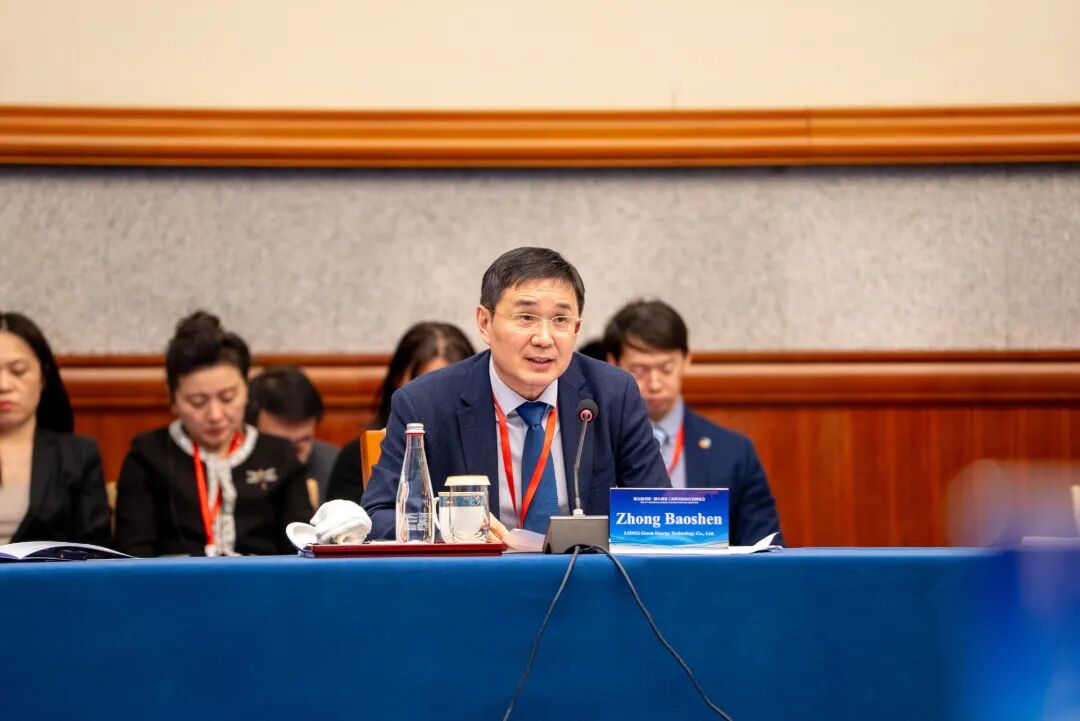
BEIJING, Nov. 20, 2026 -- The 9th China-Australia CEO Roundtable was held at the Diaoyutai State Guesthouse in Beijing. This meeting is a high-level business dialogue platform jointly attended by the Prime Ministers of China and Australia. Taking the opportunity of APEC and Australian Prime Minister Albanese's visit to China, it brings together representatives of leading Chinese and Australian enterprises to discuss new opportunities for economic, trade and investment cooperation between the two countries. Zhong Baoshen, chairman of Longji Green Energy, was invited to attend the meeting and made a keynote speech on the topic of "Strengthening Cooperation in Artificial Intelligence and Digital Technology Application" to share the practice of photovoltaic industry digitalization and the achievements of Sino-Australian green energy cooperation.
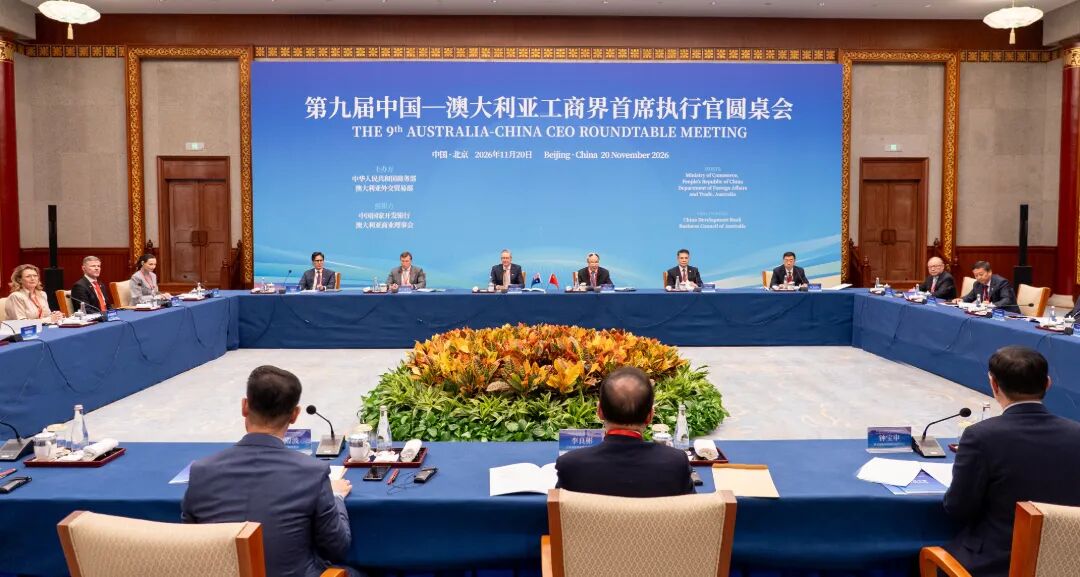
The round table was hosted by the Ministry of Commerce of China and the Australian Department of Foreign Affairs and Trade, and jointly organized by the National Development Bank and the Australian Business Council. Artificial intelligence and digital technology, green low-carbon development, smart agriculture, and professional services. Representatives of enterprises from the two countries spoke alternately to explore ways of complementary industrial cooperation. Zhong Baoshen, as the only invited representative of the photovoltaic industry, attended the seminar on artificial intelligence and digital technology and delivered a three-minute keynote speech, systematically expounding the great value of the integrated development of artificial intelligence, digital technology and green energy for Sino-Australian cooperation.
Zhong Baoshen said that at present, Sino-Australian relations continue to improve, economic and trade cooperation continues to deepen, the two countries have strong economic complementarity and high industrial compatibility, and the integration of artificial intelligence, digital technology and green energy is becoming an important direction for both sides to expand cooperation space and foster new growth momentum.
Up to now, Longji Green Energy has built a complete business system covering monocrystalline silicon wafers, batteries, components , full-scene optical storage solutions and green hydrogen equipment, covering more than 160 countries and regions around the world. The company's cumulative shipments of monocrystalline silicon wafers ranked first in the world in the past decade, photovoltaic module shipments ranked first in the world in the first half of 2026, and energy storage was listed in Bloomberg Tier 1 for 10 consecutive quarters. At the same time, Longji is also the founder and holder of the world record of conversion efficiency of crystalline silicon and crystalline silicon-perovskite tandem cells in the photovoltaic field.
In the practice of digital intelligence transformation, Longji Green Energy put forward a new paradigm of "human-oriented, AI-driven" enterprise operation. Relying on Jiaxing Base, the first lighthouse factory in the industry, more than 30 digital applications, such as AI quality inspection, intelligent dispatching and energy AI group control, have been applied to improve production efficiency by 35%, shorten product delivery cycle by 84% and reduce unit energy consumption by 20%.
At the same time, Longji practices the concept of "man-machine community", digital employees undertake standardization work, and enterprises focus on cultivating new industrial talents such as data analysts and digital translators to promote the upgrading of workers'skills; By building a unified AI capability base, we can get through the whole link data of R & D, manufacturing, supply chain, marketing and service, and drive enterprises to upgrade from process-driven to intelligence-driven.
Australia is the core strategic market of Longji Green Energy. Since the launch of industry-university-research cooperation with the University of New South Wales in 2015 and the establishment of a wholly-owned subsidiary in Australia in 2019, Longji has built a localized operation service system, covering multiple scenarios of residents, industry and commerce, and large power plants.
At present, Longji and Raystech, the local exclusive partner, have set a total delivery target of 2GW modules in 2027-2029, and the cooperation has been extended to the power station development and AIDC integrated energy field; the 5MW/20 MWh grid-level energy storage project in South Australia has been successfully connected to the grid and participated in the local electricity market transactions; At the same time, we will join hands with Ford River Group to explore the green transformation of mining industry and promote the green energy cooperation between China and Australia to a deeper level.
"Sino Australian industrial cooperation has a deep foundation and broad potential." Zhong Baoshen said that in the future, Longji Green Energy will continue to take root in the Australian market, give full play to the advantages of technological innovation, industrial synergy and localized services, continue to expand practical cooperation in photovoltaic, energy storage, integrated energy and other fields, and contribute to the upgrading of Sino-Australian industrial cooperation and global green and low-carbon development.


 浙公网安备33010802003254号